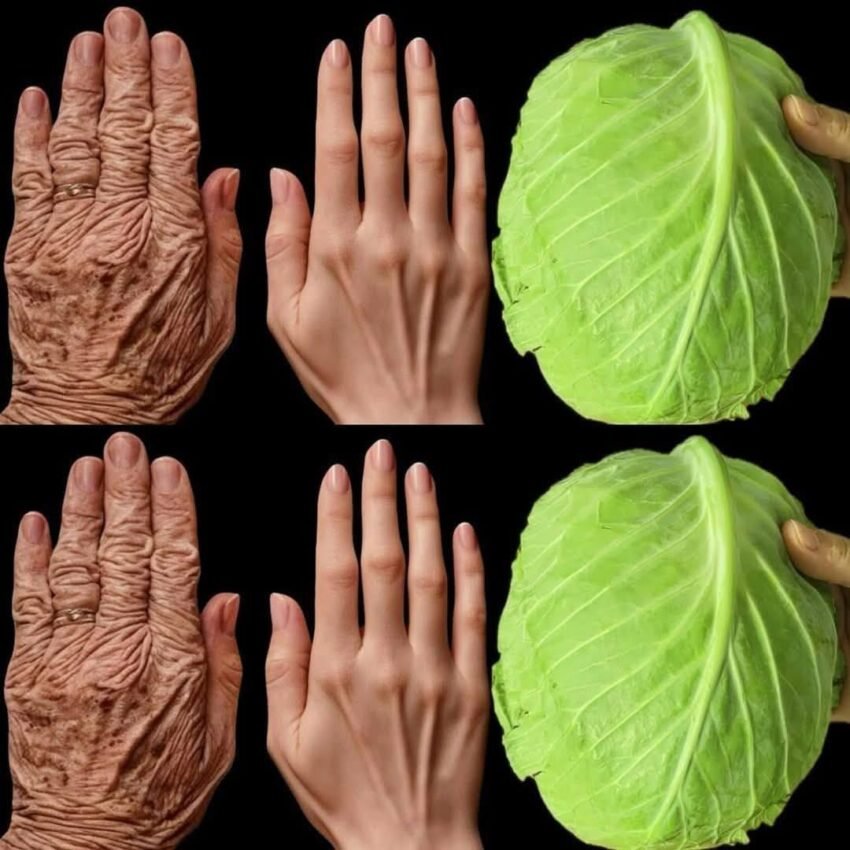
This is a very common traditional home remedy in Japan and some other cultures. The idea of applying cabbage leaves to sore joints or inflamed areas is often passed down through generations.
Here’s a breakdown of the “secret,” how it’s believed to work, and the modern perspective:
How It’s Traditionally Done:
-
Select a leaf: Take a large, outer leaf from a green cabbage.
-
Prepare it: Wash and dry the leaf. Often, the hard central stem is removed or flattened (by scoring or rolling with a bottle) to make the leaf more pliable.
-
Apply: The leaf is placed directly against the sore knee, ankle, elbow, etc. Sometimes it’s slightly bruised or cooled in the refrigerator first.
-
Secure: It’s wrapped in place with a gauze bandage or cling film.
-
Leave on: Typically left on for several hours or overnight.
Believed Benefits (Folklore & Some Science):
-
Anti-inflammatory & Cooling Effect: Cabbage leaves contain compounds like glutamine and anthocyanins (in red cabbage) which are thought to have anti-inflammatory properties. The cool, moist leaf can provide a soothing, cooling sensation similar to a cold compress, which helps reduce swelling and pain.
-
Drawing-Out Effect: A core belief is that the cabbage leaf can “draw out” inflammation or heat from the joint. This is similar to principles in traditional medicine systems.
-
Hydration and Compression: The leaf acts as a natural, moist barrier and provides gentle compression.
Modern Medical Perspective:
-
Placebo & Comfort: A significant part of the benefit may come from the placebo effect—the powerful belief that a time-honored remedy will work. The act of taking care of oneself and the cooling sensation also provide comfort.
-
Low-Risk, Complementary Care: Doctors and physiotherapists often view this as a harmless, low-cost complementary practice. The key point is that it should not replace proper medical diagnosis and treatment (like medication, physical therapy, or surgery) for serious joint conditions like osteoarthritis or rheumatoid arthritis.
-
Limited Scientific Evidence: While some small studies and anecdotal evidence from caregivers (e.g., for mastitis) suggest a reduction in surface inflammation and pain, robust scientific studies on its efficacy for deep joint issues are lacking.
The “Even at 70 Years Old” Part:
This phrase highlights the enduring nature of the remedy. It suggests that simple, natural methods can provide relief at any age, and that wisdom from the past remains valuable. It speaks to a cultural appreciation for kachou fuugetsu (花鳥風月 – experiencing nature for well-being) and te-ate (手当て – first-aid/care with one’s hands).
Bottom Line:
Applying a cabbage leaf is a safe and soothing traditional palliative care method that may provide temporary relief from the pain and swelling of sore joints. Its greatest strengths are its simplicity, zero cost, and absence of chemical side effects.
However, if you have chronic or severe joint pain, it is essential to:
-
Consult a doctor to get an accurate diagnosis.
-
Follow prescribed treatments (medication, physiotherapy).
-
You can then use the cabbage leaf as a complementary comfort measure alongside professional medical care.
So, the “secret” is less about a miracle cure and more about the wisdom of using gentle, natural methods for comfort and self-care throughout one’s life.