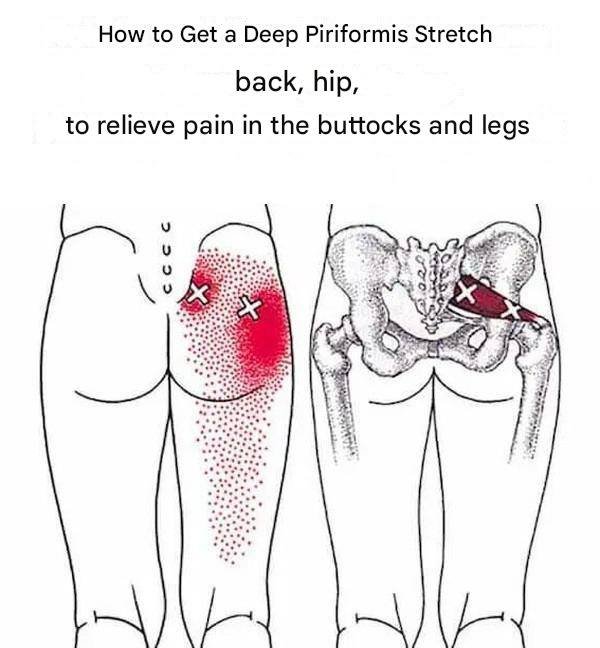
Achieving a deep, effective piriformis stretch is key to alleviating that interconnected pain in the back, hip, glutes, and legs (often sciatica). The piriformis is a small, deep gluteal muscle that, when tight or spasming, can irritate the sciatic nerve.
Here is a comprehensive guide on how to get a deep, safe stretch and eliminate that pain.
First, Crucial Principles for Success
-
Warm Up First: Never stretch a cold muscle. Do 5-10 minutes of light cardio (brisk walking, marching in place) or take a warm shower.
-
Listen to Your Body: You should feel a strong, satisfying pull, not sharp, shooting, or electrical pain. The latter indicates nerve irritation—ease off.
-
Breathe: Inhale to prepare, exhale deeply as you sink into the stretch. This relaxes the muscle and allows for a deeper release.
-
Be Consistent: Do this daily, especially if you sit for long periods. A few minutes per day is more effective than one long session per week.
-
Address the Root Cause: Stretching alone may not be enough. Consider strengthening (gluteus medius, core) and evaluating your sitting posture, gait, and footwear.
The Most Effective Deep Piriformis Stretches
Progress from beginner-friendly to deeper stretches. Hold each for 30-60 seconds, 2-3 times per side.
1. Supine Piriformis Stretch (Figure-4)
The classic and most accessible.
-
How: Lie on your back with knees bent. Cross your right ankle over your left thigh (just above the knee), forming a “figure-4.”
-
For a mild stretch: Keep your left foot on the floor.
-
For a deep stretch: Reach your hands behind your left thigh and gently pull it toward your chest. Keep your head and tailbone on the floor.
-
Feel it: Deep in the right glute.
2. Modified Pigeon Pose (Floor or Bed)
The gold standard for a deep, isolated stretch.
-
How: Start on all fours. Slide your right knee forward toward your right wrist. Your right shin will angle across your body.
-
Slide your left leg straight back. Keep your hips as square as possible (imagine headlights on your hips pointing forward).
-
To modify: If your right hip is far off the ground, place a cushion or folded towel underneath it for support.
-
To deepen: Slowly walk your hands forward, folding your torso over your front leg. Keep your spine long.
-
Feel it: Intensely in the right glute/hip.
3. Seated Piriformis Stretch (Chair)
Perfect for a quick office stretch.
-
How: Sit upright on a chair. Place your right ankle on your left thigh, just above the knee.
-
Gently press down on your right knee. For a deeper stretch, maintain a straight back and hinge forward from your hips.
-
Feel it: In the right glute.
4. Advanced: Double Pigeon Pose (Fire Log Pose)
For very flexible individuals.
-
How: Sit on the floor with both legs straight. Stack your right shin on top of your left, knees stacked as well. Your legs should resemble a triangle or a “Z.”
-
If your knees are high off the floor, sit on a cushion. To deepen, fold forward from the hips.
-
Feel it: A powerful stretch in both hips, primarily the bottom leg’s piriformis.
Pro Tips to Maximize Depth & Effectiveness
-
Use a Foam Roller First: Gently foam rolling the glutes and hips (“piriformis smash”) for 30-60 seconds can release tension and make stretching more effective. Avoid rolling directly over the bony part of your sit bones.
-
Engage in Reciprocal Inhibition: Before stretching, contract the muscle opposite the piriformis. For example, in the supine stretch, before pulling your leg in, gently press your crossed knee against your hand for 5 seconds (engaging the hip abductors), then relax and stretch. This signals the piriformis to “let go.”
-
Add Internal Rotation: In the supine or seated stretch, gently use your hand to rotate the foot/knee of the stretched leg inward slightly. This better aligns the muscle fibers.
-
Follow with Strengthening: After stretching, do exercises like clamshells, side-lying leg lifts, and bridges to strengthen the glutes. Weak glutes force the piriformis to overwork.
-
Check Your Sleeping Position: If you sleep on your side, place a pillow between your knees to keep your hips neutral. Avoid sleeping on the affected side in a fetal position.
When to See a Professional
If your pain is severe, involves numbness/weakness in the leg, or doesn’t improve after 2-3 weeks of consistent stretching and self-care, consult a professional:
-
Physical Therapist: Can provide a tailored program, manual therapy, and pinpoint the exact cause.
-
Doctor or Orthopedist: To rule out other issues like lumbar disc herniation, hip arthritis, or true sciatica.
Sample Routine (10-12 minutes):
-
Warm up: March in place for 5 minutes.
-
Foam roll glutes: 60 seconds per side.
-
Supine Piriformis Stretch: 45 seconds per side.
-
Modified Pigeon Pose: 60 seconds per side.
-
Strengthen: 2 sets of 15 clamshells per side.
-
Cool down: Lie on your back with knees bent (constructive rest) for 1 minute.
Consistency is your most powerful tool. By incorporating these stretches and principles into your daily routine, you can effectively release your piriformis and eliminate that chain of pain in your back, hip, glutes, and legs.