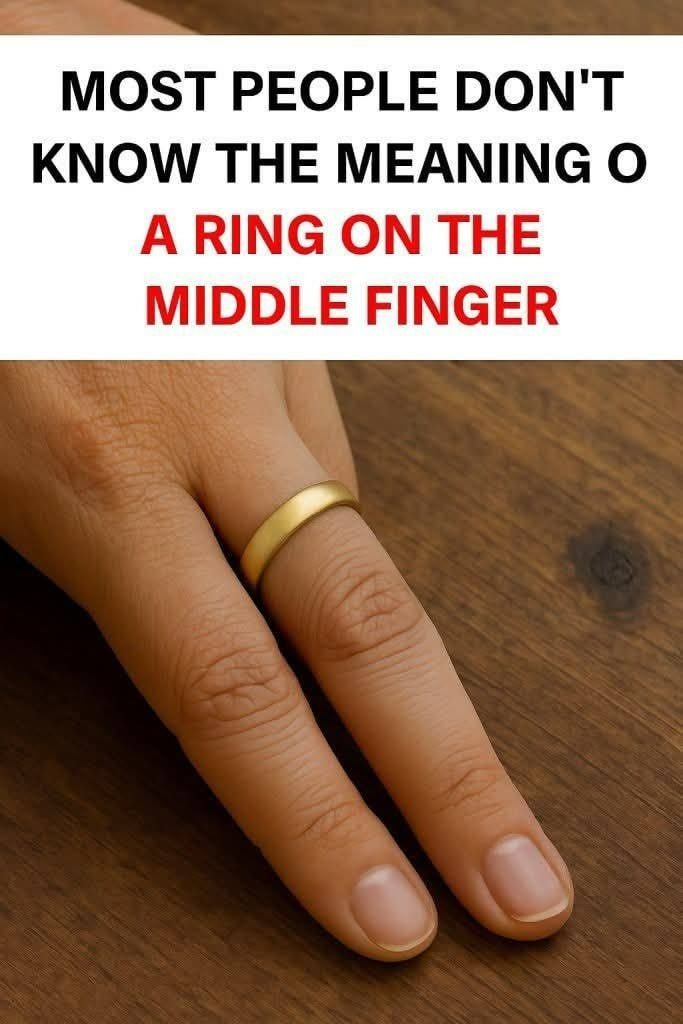
The idea that wearing a ring on the middle finger carries a “hidden meaning” is a popular topic in various traditions, from Western superstition to palmistry and modern fashion. Let’s break down the different interpretations.
Historically, the middle finger has been the least associated with symbolism in the West because it is the largest, most central, and most difficult finger on which to wear a ring comfortably. For much of history, its symbolism has been underdeveloped compared to other fingers.
However, in recent decades, interpretations have emerged in a few key areas:
1. Modern Fashion & Personal Statement
Today, the most common reason for wearing a ring on the middle finger is simply fashion and personal preference. Because it lacks the deep traditional commitments of other fingers (like the ring finger for marriage), it’s seen as a “safe” and bold choice for a statement piece.
-
Meaning: Balance, individuality, and self-expression.
-
It’s a popular finger for large, artistic, or unconventional rings because of its central location and strength.
2. Interpretations from Palmistry & Symbolism
In the practice of palmistry (chiromancy), each finger is linked to a planet and aspects of personality:
-
Linked Planet: Saturn.
-
Associated Traits: Responsibility, balance, justice, and introspection. Saturn is the planet of structure, discipline, and karma.
-
Interpretation: Wearing a ring on this finger is sometimes thought to amplify these qualities in the wearer or help channel Saturn’s grounding energy. A heavy ring could symbolize a desire for more stability.
3. Western Cultural & Superstitious Meanings
There are a few niche interpretations:
-
A Symbol of Power and Audacity: As the tallest and most prominent finger, a ring here can be seen as a bold, assertive statement.
-
Professional or Career Focus: Linked to Saturn’s themes of career and legacy, some wear a ring here to represent their professional identity or ambitions.
📊 A Quick Guide to Common Ring Finger Symbolism
To understand the middle finger’s place, it helps to see the more defined symbolism of other fingers. Here’s a brief comparison:
| Finger | Common Name | Primary Traditional Meaning (West) | Key Associations |
|---|---|---|---|
| Thumb | Will Finger | Strength of character, willpower, independence | Self-assertion, logic, freedom |
| Index | Pointer Finger | Authority, leadership, ambition | Power, direction, confidence (e.g., signet rings) |
| Middle | – | Balance & self-expression (modern) | Fashion, personal statement, introspection |
| Ring | – | Love, commitment, romance | Engagement, marriage, creativity |
| Pinky | – | Communication, intuition, status | Networking, profession (e.g., college rings), agreements |
Important Considerations
-
Cultural Variations: Meanings differ greatly across cultures. In some Asian cultures, wearing rings on specific fingers has different auspicious or inauspicious connotations.
-
Left vs. Right Hand: In Western traditions, symbolism is generally the same for both hands, though some modern interpretations assign the left hand to personal life and the right hand to public/professional life.
The Bottom Line
While other fingers carry heavier symbolic baggage (especially the ring finger), the middle finger is largely a canvas for personal style. Any “hidden meaning” is usually one the wearer chooses to assign to it, such as a reminder of personal balance or a commitment to one’s own path.
If you’re choosing a finger for a ring, the middle finger offers the most freedom from traditional expectations, allowing the ring itself to be the primary statement.